Reflection Encounters | Penumbra: Dia Art Foundation
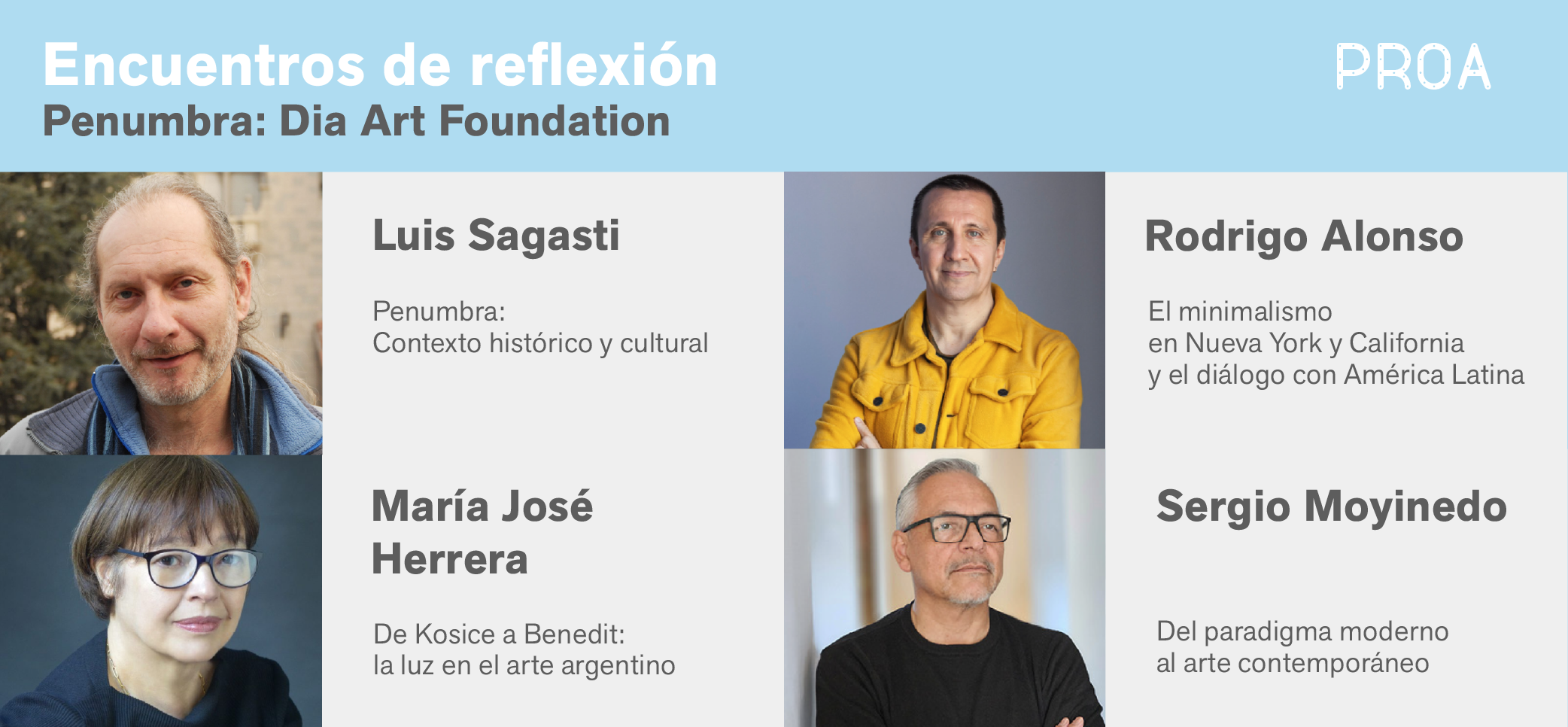
Penumbra: Historical and Cultural Context. Part I, with Luis Sagasti
Thursday, April 16, 2026
As part of the exhibition, Fundación Proa presents two sessions led by writer Luis Sagasti, inviting audiences to explore the historical, cultural, and philosophical context in which the works on view emerged.
Drawing on figures such as Michel Foucault, John Cage, Marcel Duchamp, Kurt Vonnegut, Raymond Carver, and Jorge Luis Borges, Sagasti constructs a map of the period spanning the postwar era through the end of the twentieth century: the Cold War, counterculture, the emergence of rock music, the crisis of the idea of progress, and the transformation of the contemporary subject.
Penumbra: Historical and Cultural Context. Part II, with Luis Sagasti
Thursday, April 30, 2026
Within this context, the sessions provide insight into how the major shifts in art — from Minimalism to Conceptual Art — took shape not as isolated developments, but as part of a profound transformation in the ways culture was conceived, perceived, and produced.
_______
Luis Sagasti holds a degree in History and is a professor. He teaches Introduction to the Social Sciences at the Universidad Nacional del Sur and at the university’s secondary schools. From 1995 to 2003, he was in charge of Education and Cultural Outreach at the Museum of Contemporary Art in Bahía Blanca. Among other novels and essays, he has published Lenguas Vivas, Bellas Artes, Los mares de la luna, Cybertlon, and Perdidos en el espacio. His novel Una ofrenda musical received the Second National Prize for Literature in 2022. In 2024, he was awarded the Konex Award for his literary work. His books have been translated into English, French, Portuguese, and Turkish. His latest publication, La realidad absoluta, was released in February 2026.
From Kosice to Benedit: light in Argentine art, with María José Herrera
Wednesday, June 24, 2026
Drawing on works by Gyula Kosice, Marta Minujín, Rubén Santantonín, David Lamelas, Oscar Bony, and Luis Fernando Benedit, among others, the session explores the use of light in Argentine art during the 1960s and 1970s, a period marked by the renewal of artistic languages.
María José Herrera examines a range of works and artistic experiments from Argentina in the 1960s and 1970s that incorporated light as a material, visual resource, or conceptual element. Paintings, sculptures, light boxes, and installations provide a framework for analyzing the different ways local artists employed light during a period of intense transformation in artistic languages and practices.
From Gyula Kosice’s shaped-canvas paintings incorporating fluorescent neon tubes in the mid-1940s, through Edgardo Antonio Vigo’s experiments with useless machines and the Relativuzgir’s of the late 1950s, to the vibrant neon lights drawn from urban advertising in Marta Minujín and Rubén Santantonín’s La Menesunda in the 1960s; David Lamelas’s light sculptures challenging museum conventions; Oscar Bony’s semiotic experiments; and Luis Fernando Benedit’s invisible labyrinths (1970), the session examines a body of works that reflects the diversity of aesthetic, conceptual, and political explorations present in Argentine art at the time.
The program also addresses international connections, exhibition spaces, and the institutions that fostered these experiments, all of which are essential to understanding one of the most innovative periods in twentieth-century Argentine art.
______
María José Herrera holds a degree in Arts from the University of Buenos Aires (UBA). She is a researcher, curator, and essayist. She served as Head of Research and Curatorship at the Museo Nacional de Bellas Artes (MNBA, 1999–2012) and as its Artistic Director in 2008. She was President of the Argentine Association of Art Critics from 2007 to 2016. She was Professor of Curatorial Studies at the Universidad Nacional de Tres de Febrero (UNTREF, 2010–2024), Artistic Director of MACBA in 2012, and General Director of the Museo de Arte Tigre (2014–2018). She was also a researcher at the Centro Materia, Arte y Cultura (UNTREF, 2019–2024). She is the author of Cien años de arte argentino (Biblos/OSDE, 2014).
From the Modern Paradigm to Contemporary Art, with Sergio Moyinedo
The art historian and researcher analyzes the transition from modern to contemporary art through the transformations that shaped American artistic production in the 1960s and 1970s.
Sergio Moyinedo — an art historian, researcher, and professor specializing in modern and contemporary art — examines the shift from the modern paradigm to the practices that gave rise to contemporary art.
Taking the works featured in Penumbra: Dia Art Foundation as a starting point, the conversation addresses the “conceptual state” that characterized much of American art in the 1960s and 1970s, when matter, light, color, space, and the viewer’s experience became central to investigations that reconsidered the foundations of artistic practice. Works by Walter De Maria, James Turrell, Robert Irwin, Richard Serra, Agnes Martin, and John Chamberlain represent this period of experimentation with artistic language. In contrast, Felix Gonzalez-Torres’s work introduces questions related to memory, affect, and the political dimension, expanding the discussion toward social experience.
Moyinedo examines the transformations that reshaped the artistic landscape at the end of the twentieth century and offers an interpretation of the continuities and ruptures that explain the transition from modernity to contemporary art.
______
Sergio Moyinedo teaches undergraduate and graduate courses on modern and contemporary art at the Faculty of Arts of the National University of La Plata (UNLP) and the Department of Arts Writing at the National University of the Arts (UNA). At the latter, he directs the Master’s Program in the History of Modern and Contemporary Art and is a member of the research team Contemporary Processes of Artification: Approaches from Theories of Mediatization and Enunciation. He has directed several research projects on contemporary art and has published extensively on the subject.